There were a few quotes in the Adler issue that I found interesting and would like to comment on:
In reference to Helen’s reflection she indicated that she had “gone on too long.” I find that whenever I discuss the vocabulary associated with a concept the pacing is really important. If I stay on a subject too long then I lose the attention of a large portion of the class. For example, when discussing slope with relation to any given linear relation and graph, it’s important for me to recognize when it’s time to move on and come back to the concept at another opportunity. I realize that slope is an important idea but there is always a point when the students tune out.
“some mathematical ideas are difficult for pupils to verbalize precisely and with meaning”
I find that some students hate verbally communicating what they are working on. I was like that. Sometimes the concepts are hard to put into words, and a student will make the argument that in showing the work mathematically they are still ‘communicating’ what they are doing, just not verbally. I still believe that communicating using words is an important activity, but only when appropriate. In addition, I sometimes feel that because much of the math is often out of any context, communicating what is happening is made that much more difficult.
Wednesday, March 2, 2011

Tuesday, March 1, 2011
Bilingual mathematics learners
Reading through the article by Moschkovich, i feel that there has been a connection made to the term "deficiency" , "of vocablary" and "multiple meanings". This association has a very negative conotation to it as in classifying students entirely incapable due to such gaps in their language. However, i feel we cannot ignore these gaps as they influence theire capability in communicating in a foreign language.Even though it is sad that assessment is based on students' capability of interpreting mathematical concepts in the foreign language, it is only fair to expect that students' be able to convey their understanding to their peers. This would ensure their success as citizens in the foreign country.
Therefore, i cannot completely dismiss the fact that emphasis should be given on vocabulary building and understanding of multiple meanings.
I do however, agree with the article in that too much emphasis on english vocabulary can deter students from advancing further as they would get de-motivated from constant stress. Their success should be celebrated as well, if they are capable of explaining a concept through diagrams,gestures and stories in simple language it is crucial to make account of this and motivate students further to make such associations.
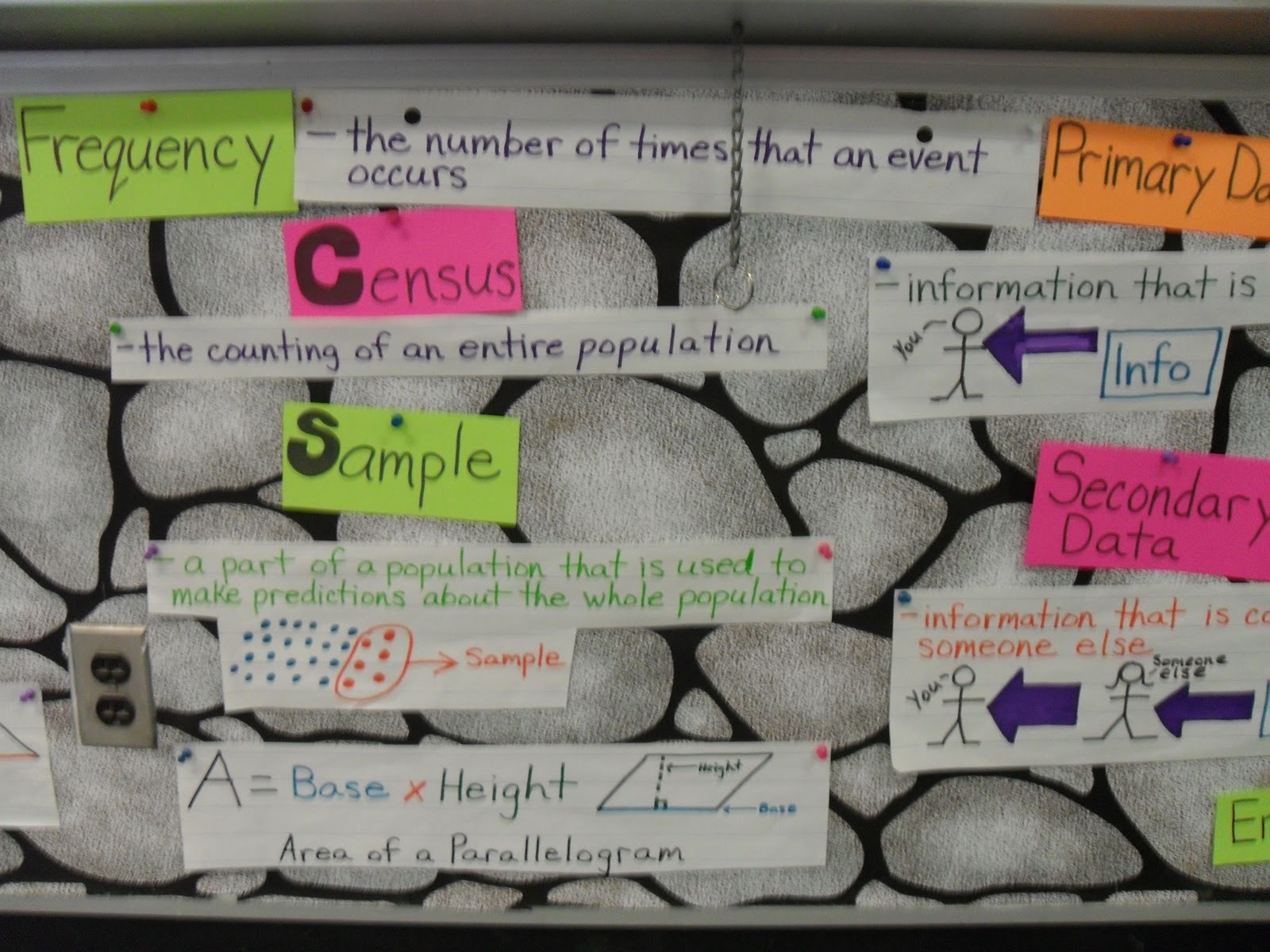
Example of a word wall
Here's an example of a word wall that has a picture or example attached to it. It's from a Grade 7 classroom.
I wonder if a tool like this would be helpful for students and make room for the mathematics.


I wonder if a tool like this would be helpful for students and make room for the mathematics.


Monday, February 28, 2011
Some thoughts on language and how we use it
I found a few aspects of the Adler article particularly interesting. The first is the idea that explicitly teaching math vocabulary could be a bad thing. I have never taught it as rigidly as it was explained in this article, but it is a good reminder that we shouldn’t get weighed down by any one aspect. Focusing on any one aspect in math means that you are not giving a balanced approach and are neglecting some areas. It is important that we encourage proper use of mathematical language, but there is a difference between explicit teaching of the language and making the lesson about the language. I think we should teach all learners about how to use the language in order to communicate their ideas clearly, but this is only skill among many
I found this quotation from the Moschkovich article really stuck out to me: “Words have multiple meanings, meanings depend on situations, and learning to use mathematical language requires learning when to use different meanings” (page 91). This reminded me of our discussion last class about the definition and meaning of variables. There were a number of ways that the word could be used that would change how I would explain its use in that context and now I’m wondering what other words I use that have this type of multiple meaning – I am listening to myself more carefully now.
I found this quotation from the Moschkovich article really stuck out to me: “Words have multiple meanings, meanings depend on situations, and learning to use mathematical language requires learning when to use different meanings” (page 91). This reminded me of our discussion last class about the definition and meaning of variables. There were a number of ways that the word could be used that would change how I would explain its use in that context and now I’m wondering what other words I use that have this type of multiple meaning – I am listening to myself more carefully now.
Clarification on Invisibility/Visibility, and other thoughts
I enjoyed Adler’s article, but at times I understood and then felt that I didn’t understand the ideas of invisibility & visibility, and would love to hear from others to see if I am on the right track.
With respect to understanding mathematics and how the acquisition of the mathematical language can be a hindrance to gaining or showing that understanding through the invisibility/visibility lens, my interpretation:
‘talk’ can be a resourceful tool and the mathematical language does need to be seen (has a purpose, ‘visible’) with respect to both vocabulary and notation that we would like our students to learn; however, there are times when the language should ‘disappear’, become ‘invisible’, especially (at the beginning stages?) of student learning – when they are ‘practicing’ what they are learning, showing their understanding, yet they may not be doing so in the conventional way that math teachers, in general, would like to see/prefer/hope for. This would allow the students to gain an understanding of the concepts in their own words before learning to express in a more conventional manner.
I would really like to hear if I am on the right track, please. Thank you.
Similar to Vivian’s concerns, I too wondered if I have been putting too much emphasis on acquisition of math language both vocabulary (do love those ‘let statements) and notation as a way ensuring understanding of math ideas. Then there was another line that struck me as well – Helen’s concern as to whether or not “saying it [was] actually indicative of understanding, of knowing” (Adler, 1999, p.56). The reason why this line struck a chord for me was because I was in fact a student who could do the math without ever understanding what I was actually doing. It was becoming a teacher that helped me to really understand how and why things ‘worked’ in mathematics. Then a few years ago, I took a math course and discovered that as a student I hadn’t changed – I could still be successful without understanding. I have to say that this was somewhat distressing and made me more determined to ensure that my students did not feel the same way. I tried to ensure this understanding through various real world problems and projects, but I too used techniques that were similar to Vivian’s. I felt that good communication, through proper vocabulary and notation, would help students to gain better mathematical understanding. I understand the confusion that Vivian expressed, as I feel it too. I guess the key, if I understood both readings correctly, is to find balance and to allow students to express themselves initially through different mediums and over time, guide to the more conventional math language.
I guess having said this, who is to say that proper math language is truly ever needed? If students ‘get it’, no matter how it is expressed, isn’t that enough? Food for thought…
Sunday, February 27, 2011
Mathematics content being lost in language instruction
This week's reading was particularly interesting to me because of my current practice in my math classroom. I've been making an effort to help students better communicate mathematically (translation: getting better marks in the Communication category of their assessments) through three main methods.
1) Creating a word wall - I posted a chart paper at the front of the class and I add new or key vocabulary to it throughout the day's lesson
2) Communication questions - I add test-type questions to a list of "Communication" questions at the end of every lesson (e.g. Explain the similarities and differences between partially factoring and averaging the zeros methods of finding the max/min of a quadratic.)
3) Deconstructing the question stem - I've been making a conscientious effort to go through a word problem line by line, asking students to clarify what the question is asking them to find in mathematical terms
Reading Helen's exchange with her students and her reflections afterward made me think about my own teaching methods in the area of explicit mathematical language teaching. Am I driving my students crazy by telling them over and over again that proper mathematical language needs to be used? Of course. Did I think that I was doing the right thing by my students? I did. Now, however, I'm not so sure...does it matter that the students say "square root" instead of "radical"? Does it matter that they write precise "let statements"? I thought that it did, for proper mathematical form...but now I'm so confused!
I've been emphasizing so much mathematical language acquisition because I too believe that "being explicit about mathematical language benefited all pupils in their mathematics classes, irrespective of their language histories" (p.48). I've been further motivated to be explicit about mathematical language due to a third of my classes having recent Visa students from China; although these students (for the most part) know the math, they don't always know the correct terminology so I felt that the language focus would be most beneficial for them. However, I've also seen the result of having too much focus on the proper language "[obscuring] the mathematics under consideration" (p.62). I've yet to strike the balance and wish that I had some examples of how to properly teach language acquisition in the math classroom while at the same time ensuring that the math content is learned and not having a lesson or teaching style that is too confusing for students to grasp...
Thursday, February 24, 2011
Links from last nights discussions
Ourr group discussed many possibilities for meeting the needs of all students and bringing in the community. Here are links for any one interested:
A brief intro to Lesson study from professionally speaking. If you want to know more this is the area of my research and love to talk about it.
Job prospects for New Teachers
Technological Studies includes computer science courses
Math and physics used to be the two most hireable of the Intermediate senior qualifications
http://professionallyspeaking.oct.ca/december_2004/reports.asphttp://professionallyspeaking.oct.ca/december_2007/transition_english.asp
Hope these help
Subscribe to:
Posts (Atom)